

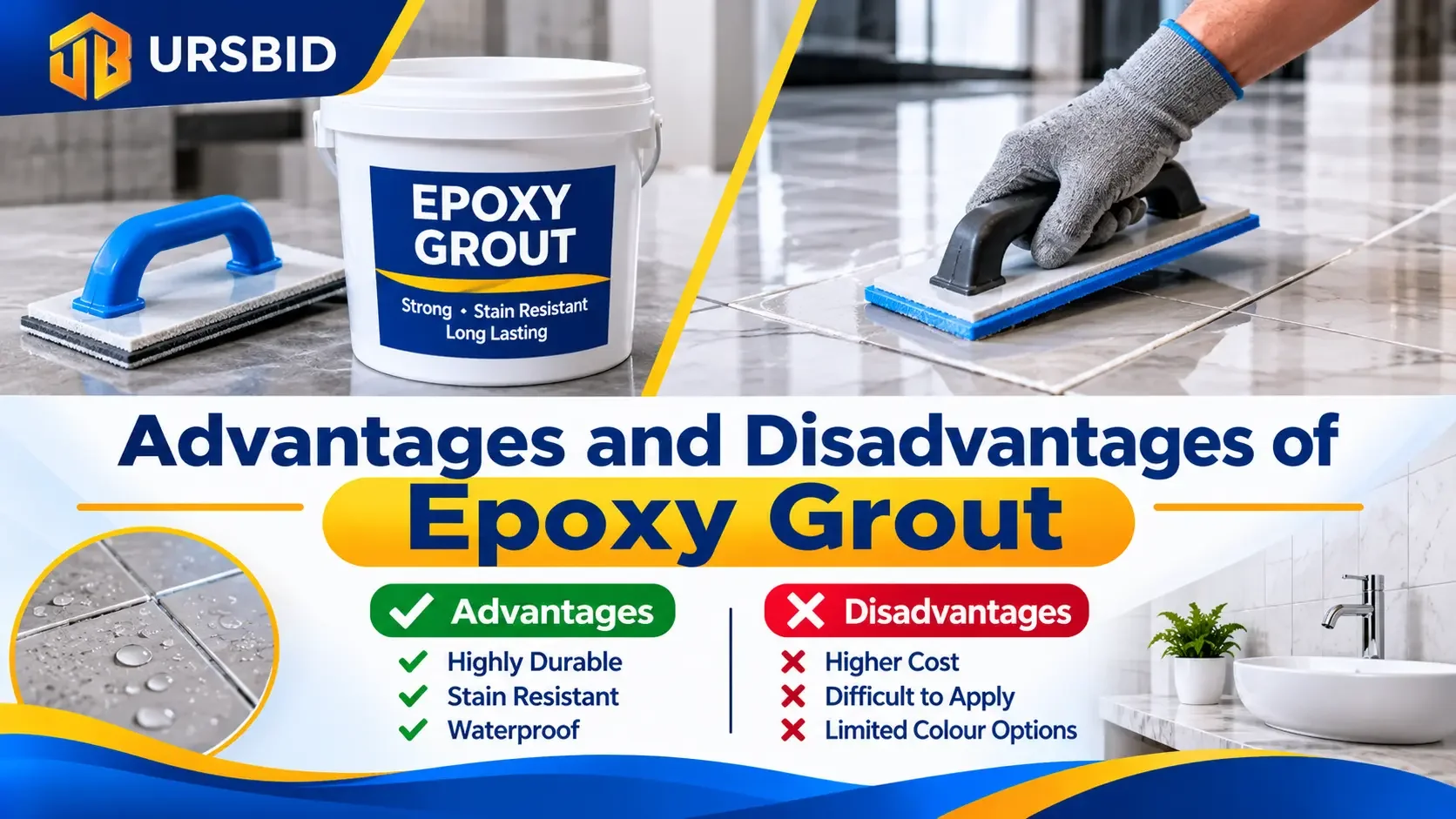
A tiler shows you two samples of tile joints. One is cement grout, grey and slightly rough. The other is epoxy grout, smooth and even, like plastic. He says, "Epoxy is better, but it costs more." That is true, but it is only half the story. Epoxy has real strengths. It also has real weak points that nobody mentions in the showroom.
This guide lists the advantages and disadvantages of epoxy grout in plain words. You will see where it shines, where it causes trouble, and how to decide if it is worth the extra money.
What Are the Advantages of Epoxy Grout?
The main advantages of epoxy grout are that it is non-porous, stain-resistant, and needs no sealing. It also keeps its colour well and resists chemicals.
- Non-porous. Epoxy does not soak up water, dirt, or oil. Stains and mould have little to grip.
- No sealing. Cement grout needs sealing from time to time. Epoxy does not.
- Stain resistance. Turmeric, tea, coffee, and cleaning liquids wipe off easily.
- Even colour. The joints keep their shade for years and do not turn patchy or grey.
- Strong and crack-resistant. It is hard and does not powder or crumble the way old cement grout can.
- Chemical resistance. It copes with strong cleaners and with spills in kitchens and labs.
- Low upkeep. A damp cloth is usually enough for cleaning.
(Advantages source:BuildWiz, Epoxy Grout Guide, a UK guide.)
What Are the Disadvantages of Epoxy Grout?
The main disadvantages of epoxy grout are its high price, short working time, and difficult application. It is also hard to fix once it cures.
- High cost. Epoxy grout costs about Rs 700 to 1,100 or more per kg, compared with about Rs 70 to 150 for cement grout. Tilers also charge about 20% to 40% more to apply it.
- Short working time. You have about 30 to 60 minutes at room temperature. In heat, it can be under 20 minutes.
- Hard to apply. It needs careful mixing, quick work, and early cleaning of the tile surface.
- Haze on tiles. If you leave it too long, cured epoxy haze is very hard to remove and may need a special remover.
- Temperature sensitive. It works best between about 15°C and 30°C. Cold slows the cure.
- Hard to fix or remove. Once it cures, grinding it out is slow and hard.
- Needs a skilled tiler. A beginner can ruin a whole bathroom.
Epoxy Grout Pros and Cons at a Glance
Here are the epoxy grout pros and cons side by side. The pros are mostly about how the joint performs. The cons are mostly about price and the work needed.
|
Pros |
Cons |
|
Non-porous, very stain-resistant |
Costs far more per kg than cement grout |
|
No sealing needed |
Short working time, about 30 to 60 minutes |
|
Colour stays even |
Hard to clean off tiles once cured |
|
Strong, rarely cracks or powders |
Needs a skilled tiler, who may charge more |
|
Handles chemicals and moisture |
Slow cure in cold weather |
|
Very low upkeep |
Hard to remove or repair later |
Is Epoxy Grout Worth It?
Epoxy grout is worth it in wet, stain-prone, and busy areas. In dry rooms, good cement grout is usually enough.
Look at a real example. A 100 sq ft bathroom floor is about 9.3 square metres. One UK guide says a 5 kg epoxy kit covers about 6 to 12 square metres of 3 mm joints, so you need about 4 to 6 kg. At Rs 700 to 1,100 per kg, the epoxy costs about Rs 2,700 to 6,400. The same area in cement grout is only about Rs 200 to 900. That is my arithmetic from the two sources above.
So the extra cost for one bathroom floor is a few thousand rupees. For a shower floor that stays wet every day, that is usually a fair price to avoid black joints and regrouting. For a bedroom floor, it is not.
What Are Common Epoxy Grout Problems, and How Do You Avoid Them?
Most epoxy grout problems come from poor mixing, slow cleaning, or the wrong temperature. Each one is easy to avoid with care.
- Haze on the tile face. Clean the tiles with a damp sponge while the grout is still soft, not after it cures.
- Grout hardens in the bucket. Mix only what you can use in about 30 minutes. Do not make a big batch.
- Joints do not set well. Mix the exact parts as the maker directs. Do not change the ratio.
- Slow or soft cure. Work between about 15°C and 30°C. Avoid cold, damp conditions.
- Uneven joints. Press the grout in fully with a rubber float, and keep the joints a steady width.
- Dirty joints before grouting. Clean out dust and adhesive first, or the grout will not bond.
- Colour looks different on the wall. Check the colour against your tile in your own light before you buy.
Epoxy cures in about 24 to 72 hours, so keep water and traffic away until then.
Who Should Use Epoxy Grout, and Who Should Skip It?
Use epoxy where water, stains, or chemicals are a constant problem. Skip it where the cost is not justified.
Good places for epoxy grout:
- Shower walls and shower floors
- Bathroom floors
- Kitchen counters and backsplashes
- Balconies, pools, and wet terraces (with an outdoor-rated product)
- Commercial kitchens, labs, and hospitals
Places where you can skip it:
- Bedroom and living room floors
- Dry wall tiles
- Very tight budgets with dry rooms
- Jobs without a skilled tiler
In the middle are kitchen floors and bathroom walls. Many homes use polymer-modified cement grout there, and epoxy only in the wettest zone.
What Mistakes Should You Avoid With Epoxy Grout?
- Do not give the job to an unskilled worker. You can findfinishing and flooring work services on URSBID for tile work.
- Do not decide by the price per kg alone. Compare coverage, labour, and the years of upkeep you save.
- Do not grout before the tile adhesive has set. Wait as the adhesive maker advises.
- Do not skip the colour check. Look at a larger sample next to your tile.
- Do not ignore the joint width on the pack. Each product works in a set range.
Where Can You Buy Epoxy Grout Online?
You can buy epoxy grout online through URSBID by posting your requirement and getting quotes from verified suppliers.
Once you know the area and the colour, the next step is to compare rates. ToBuy Epoxy Grout Online through URSBID, say clearly that you need epoxy grout for tile joints. Share the colour, quantity, and delivery place. Registered vendors will send their quotations directly to you. Ask each one for the coverage per kit and the working time.
Frequently Asked Questions
What are the advantages of epoxy grout?
Epoxy grout is non-porous, stain-resistant, and needs no sealing. It keeps an even colour, is strong, and resists chemicals.
What are the disadvantages of epoxy grout?
It costs much more than cement grout, has a short working time of about 30 to 60 minutes, and is hard to apply and clean up. It is also hard to remove once cured.
Is epoxy grout worth it?
It is worth it in showers, wet floors, kitchens, and busy areas. In dry rooms, good cement grout is usually enough.
How much more does epoxy grout cost than cement grout?
Epoxy is roughly ten times the price per kg. For one 100 sq ft bathroom floor, the extra cost is usually a few thousand rupees.
Does epoxy grout need sealing?
No. It is non-porous and does not need sealing.
Final Thoughts
Epoxy grout is a strong product with a clear price. It keeps joints clean, even, and mould-free, but it costs more and asks a lot of the tiler. Use it where water and stains are a daily problem. Use cement or polymer-modified grout in dry rooms. Hire a skilled tiler, mix small batches, and clean early. Then your tile joints will look as good as the tiles.
Ready to compare prices?Get epoxy grout rates on URSBID by posting your requirement, and receive quotes from verified suppliers.